Student Housing Costs in the 2026 Summer Semester: Rooms in Shared Apartments Average €512

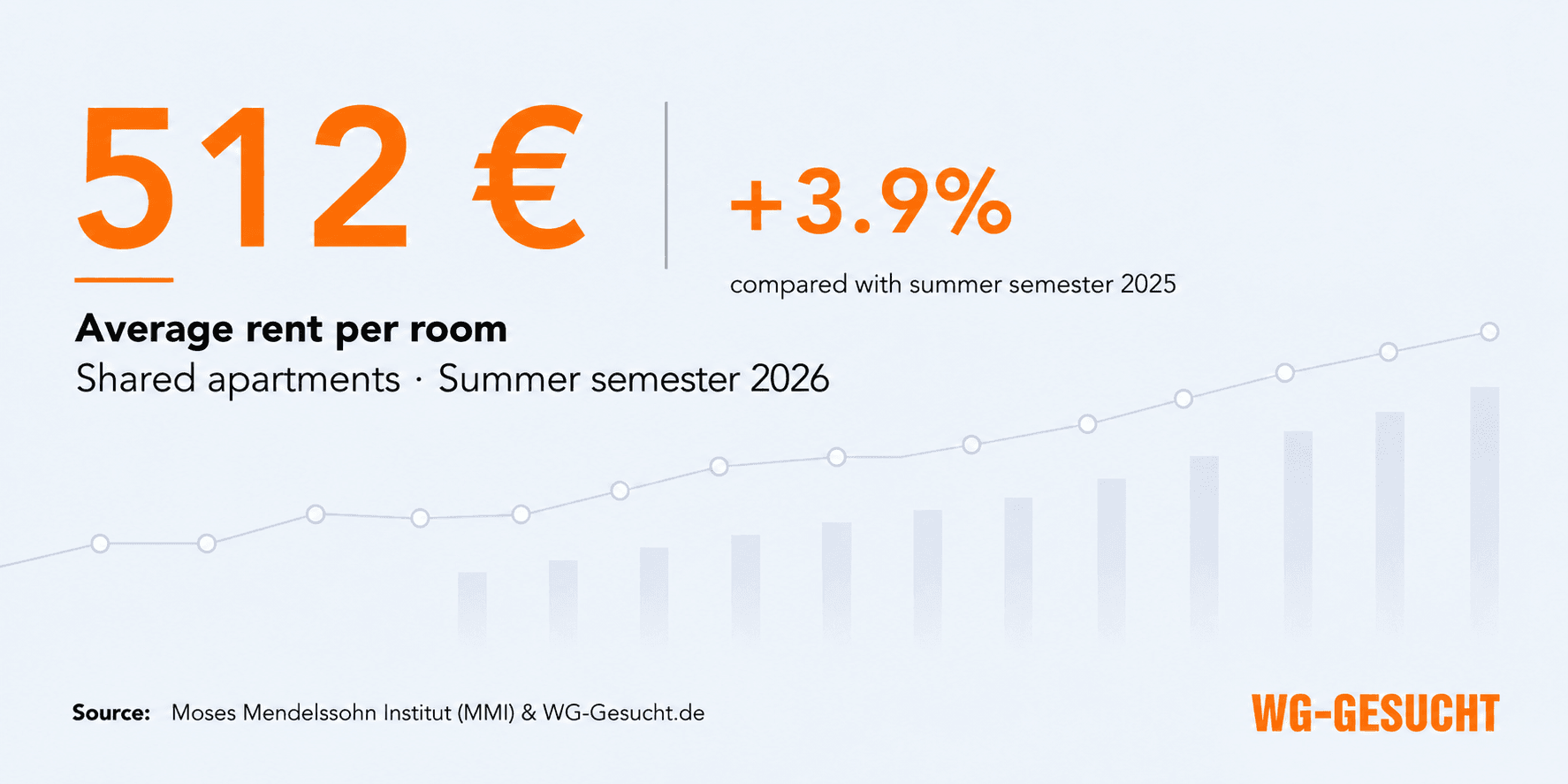
Average rent for a room in a shared apartment in the summer semester 2026: 512 euros, 3.9 percent higher than in the summer semester 2025.

Student housing costs in Germany continue to rise. In the summer semester 2026, the average advertised monthly rent, including utilities, for a room in a shared apartment was €512 in German university cities – 3.9 percent more than a year earlier. Affordable rooms are becoming increasingly scarce.

The latest analysis by WG-Gesucht.de and the Moses Mendelssohn Institute (MMI) covers 89 German university locations with more than 5,000 students. It shows that rent increases have slowed compared with the sharp rises of previous years. However, prices remain at a very high level and continue to increase faster than general inflation.

Key findings at a glance

  • A room in a shared apartment in Germany cost an average of €512 per month in the summer semester 2026.
  • This represents an increase of 3.9 percent compared with the previous year.
  • The analysis covers 89 university locations with more than 5,000 students.
  • Finding accommodation is becoming increasingly difficult for students on limited budgets.

Affordable rooms are becoming increasingly scarce

While average rents have partly stabilised in some major cities, conditions are changing in the lower-priced segment of the market. Affordable rooms are becoming scarcer and are attracting increasingly high demand.

According to the MMI, the apparent easing of the market is therefore misleading. People with limited housing budgets have fewer options. This affects not only students, but also trainees and other people on low incomes.

This development is clearly visible on WG-Gesucht.de:

“On our platform, we are seeing demand become extremely concentrated on the remaining comparatively affordable rooms. Many of these listings are taken on the same day they are published. For students, finding accommodation is increasingly becoming a race in which those who respond quickly and apply immediately often have the best chance. At the same time, we are seeing many people broaden their search and make greater compromises regarding location or room size in order to find suitable accommodation.”

Annegret Mülbaier, WG-Gesucht.de
Translated from German

Housing costs remain a major challenge for students

Germany’s BAföG student support scheme included a monthly housing allowance of €380 in the summer semester 2026. At many university locations, this amount did not cover the actual cost of a room in a shared apartment. Around five out of six students were enrolled at university locations where average housing costs already exceeded the allowance.

The situation was particularly difficult for students on limited budgets. At university locations attended by almost two-thirds of students, even the lower-priced rooms exceeded the housing allowance.

According to the analysis, a potential increase in the allowance to €440 would only partially close the gap. A considerable proportion of students would still face higher housing costs.

Significant regional differences in housing costs

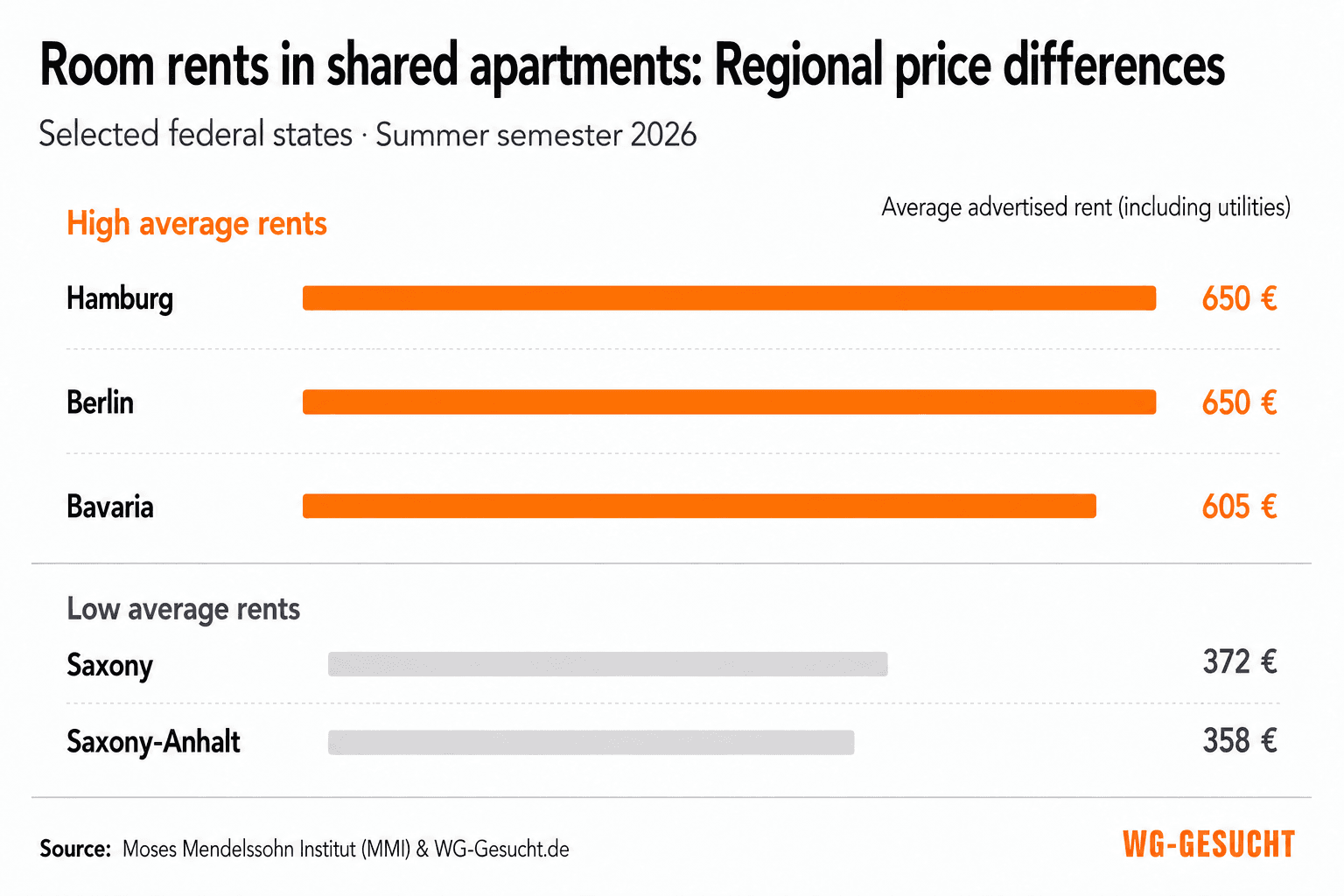
The amount students pay for a room in a shared apartment varies considerably across Germany. Average shared-room rents differed by almost €300 between the federal states highlighted in the analysis. At the same time, the existing gap between western and eastern Germany is gradually narrowing. Rents have recently increased in eastern German university cities as well, although from a lower starting point.

Regional differences in shared-room rents in Germany in the summer semester 2026: €650 in Hamburg and Berlin, €605 in Bavaria, €372 in Saxony and €358 in Saxony-Anhalt.

There are also considerable differences within individual federal states. This is particularly apparent in North Rhine-Westphalia: while a room in a shared apartment cost an average of €630 per month in Düsseldorf and €620 in Cologne, average rents were €385 in Bochum and €375 in Bielefeld. State-level averages can therefore conceal very different local housing markets, particularly in Germany’s larger federal states.

Rent trends also varied between major university cities. In Munich and Berlin, average advertised rents remained unchanged compared with the winter semester 2025/26, although they were already at a high level of €800 and €650 respectively. Average housing costs increased by €30 to €650 in Hamburg and by €20 to €620 in Cologne.

Energy and utility costs remain a source of uncertainty

In addition to basic rents, energy and other utility costs remain an important factor in the future development of student housing costs.

“Utility costs account for a comparatively large proportion of the total cost of rooms in shared apartments and student residences. If energy prices rise further as a result of the current global situation, the recent moderate rent trend could quickly accelerate again.”

Dr Stefan Brauckmann, Moses Mendelssohn Institute (MMI)
Translated from German

According to the MMI, a sustainable reduction in housing costs requires a greater supply of affordable apartments and rooms in student residences.

Methodology

The study covers all German university locations with more than 5,000 students. Distance-learning institutions and universities of public administration are not included.

The sample for the summer semester 2026 comprises 10,542 listings. It includes rooms offered on an open-ended basis in existing shared apartments occupied by a total of two or three people. Swap offers are excluded.

All prices are monthly rents including utilities. In most cases, they also include electricity and internet, as well as the furniture and technical equipment provided in shared areas.

For each university location, the analysis reports the first quartile, median and third quartile. The nationwide average is weighted according to student numbers: the median for each city is weighted by the number of students enrolled there and then combined to calculate the national figure.

Further analyses of student housing costs in Germany

WG-Gesucht.de and the Moses Mendelssohn Institute have continuously analysed shared-room rents since 2013. Our overview “Student Housing Costs in Germany” provides the complete historical data series, long-term rent trends and further analyses of Germany’s student housing market.

Press contacts

Data, market trends and insights from WG-Gesucht.de

Do you need additional data on shared-room rents, individual university locations or developments in Germany’s student housing market? We can provide journalists and editorial teams with additional data, regional analyses and background information.

Annegret Mülbaier
Press & PR, WG-Gesucht.de
pr@wg-gesucht.de

Questions about the study and interview requests

Dr Stefan Brauckmann
Moses Mendelssohn Institute (MMI)
Presse-FM@moses-mendelssohn-institut.de

Topics of this article