Your first apartment: costs, checklists and tips for first-time renters

Sort out costs and the contract beforehand, and you can focus on settling in after the move.

A common rule of thumb: the rent including heating and service charges (Warmmiete) should be no more than 30 percent of your net income. With 1,800 euros net, that would be 540 euros. In expensive cities such as Munich or Frankfurt, that is often hard to achieve. Then you have to budget more, give up some space or look further out.

On top of the rent come other running costs: electricity, internet, the TV and radio licence fee (Rundfunkbeitrag) and insurance. Plan a buffer for these.

What does moving in cost?

Item Rough amount
Deposit (Kaution) up to three months' net rent, payable in three monthly instalments
First rent one month's rent, pro rata if you move in mid-month
Move around 200 to 1,500 euros, depending on distance and helpers
Furnishing around 500 to 5,000 euros, depending on what you already have

How you get your deposit back when you move out is explained in the article Getting your deposit back.

searchSearching for an apartment

Reading listings

German apartment listings use the same abbreviations again and again:

  • KM (Kaltmiete) is the net rent, without service charges.
  • NK (Nebenkosten) are the service charges, for example for water, waste collection and cleaning of the building.
  • WM (Warmmiete) is the gross rent: net rent plus service charges and usually heating.
  • Provision or Courtage is the estate agent's fee. As a rule, the landlord pays it, because they hired the agent.
  • Erstbezug means nobody has lived in the apartment before you.

If a listing says "renovierungsbedürftig" (in need of renovation), estimate the cost and effort realistically before you agree. You can find current offers under apartments.

The viewing

Write down your questions beforehand, for example about heating costs, the last service charge statement, internet and parking. On site, check the windows, doors, water pressure and sockets, and take photos of any existing damage. A detailed checklist is in the article Flatshare casting and apartment viewing.

Application documents

Landlords usually ask for these documents:

  • a copy of your ID or passport
  • a tenant self-disclosure form (Mieterselbstauskunft)
  • proof of income for the last three months; students can also bring their BAföG notice or a guarantee from their parents (Bürgschaft)
  • a credit report
  • a certificate from your previous landlord confirming you have no rent arrears (Mietschuldenfreiheitsbescheinigung), if you have rented before

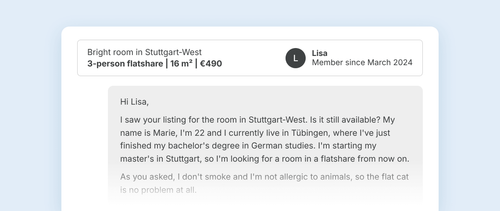
The easiest way is to keep everything together in an application folder. At the viewing, however, the landlord may only ask for your contact details. Proof only has to be shown once you seriously want the apartment. How to write your message to the landlord is explained in the article How to write a flatshare or apartment application.

descriptionThe rental contract

Read the whole contract before you sign, including the attachments and the house rules (Hausordnung).

Term and notice

The normal case is an open-ended contract. It gives you the best protection. A fixed term needs a legal reason, otherwise the contract counts as open-ended. As a tenant, you can give three months' notice. More in the article Regular termination of a rental contract.

Cosmetic repairs

Many contracts say whether you have to repaint when you move out (Schönheitsreparaturen). Rigid schedules such as "repaint every three years" are usually invalid, and so are renovation duties if you took over the apartment unrenovated. More in the article Renovation duties when moving out.

Service charges

You pay the service charges in advance every month. Once a year, the landlord settles them, and you either pay extra or get money back. Ask to see the last statement so you don't get a nasty surprise. How to check it is explained in the article Understanding and checking your utility cost statement.

Handover report

Walk through the apartment together with the landlord when you move in. Record all damage, the meter readings and the number of keys in writing, and take photos. This protects you from unjustified claims when you move out. A template is in the article Handover report.

checklistChecklist: what you need for your first apartment

From day one

  • bed and mattress, bed linen, towels
  • wardrobe or clothes rail
  • table and chair, plus a desk for studying or working from home
  • fridge and cooker, if there is no fitted kitchen
  • pot, pan, cutlery, plates, glasses and cups
  • toilet paper, shower curtain and cleaning products

Often forgotten

  • lamps and light bulbs, because many apartments are handed over without lamps
  • a bathroom mirror
  • tools: hammer, screwdriver, spirit level, wall plugs
  • extension cable and power strip
  • first aid kit

How to plan the move itself is explained in the article Planning a move.

keyAfter moving in

Registering your address

Within two weeks of moving in, you have to register at the citizens' office (Bürgeramt). You need your ID and the landlord confirmation (Wohnungsgeberbestätigung), which your landlord issues. If you register late, you risk a fine.

Recording meter readings

On the day you move in, read the meters for electricity, gas and, if there is one, water, and take photos. Report the readings to your energy supplier. As a tenant, you usually sign your own contract for electricity and often also for gas.

Updating your address

Give your new address to your employer or university, your bank, your health insurance and your other insurance companies, among others. A mail forwarding order with Deutsche Post (Nachsendeauftrag) helps during the transition. The TV and radio licence fee is paid once per apartment. Register for it with the contribution service (Beitragsservice).

Insurance

Personal liability insurance (Privathaftpflichtversicherung) is the most important one. It pays if you cause damage to others, for example a water leak into the apartment below. It often costs less than 100 euros a year. Contents insurance (Hausratversicherung) is not compulsory, but it protects your own belongings in case of burglary, fire or water damage.

warningCommon mistakes

Budgeting too tightly

Many people only calculate with the net rent and underestimate the one-off costs. Calculate with the gross rent plus electricity, internet and the licence fee, and keep a financial cushion for moving in.

No handover report

Without a report, it's almost impossible to prove when you move out that damage was already there. That can cost you part of your deposit.

Not reading the contract

Clauses on cosmetic repairs, pets or subletting often only come to light when it's too late.

Signing too quickly

Even if the market is tight, take at least an evening to read the contract calmly.

An overview of your rights as a tenant is given in the article Tenancy law for tenants in Germany. Answers to more typical questions are in 10 questions from tenants.

Frequently asked questions about your first apartment

Plan for the deposit of up to three months' net rent, the first rent, the cost of the move and furnishing. You may pay the deposit in three monthly instalments. How much furnishing costs depends heavily on what you already have.

Register at the citizens' office within two weeks, record the meter readings, sign contracts for electricity and internet and give your new address to everyone who needs it.

Usually electricity, internet, the TV and radio licence fee and insurance. Electricity is usually not included in the service charges, so you pay it directly to your supplier.

It's not compulsory, but it makes sense if you own furniture and appliances of some value. Personal liability insurance is more important.

Normal wear and tear is the landlord's responsibility. You have to pay for damage you cause. For damage to others, for example your neighbour, your liability insurance steps in. Report any damage to your landlord in writing and promptly.

Note:
Our content is carefully researched and regularly updated. It provides general guidance on creditworthiness and apartment hunting and does not replace individual legal or financial advice.

The content on this page is protected by copyright.

More topics about Finding a home